Home · Economy & Cost of Living
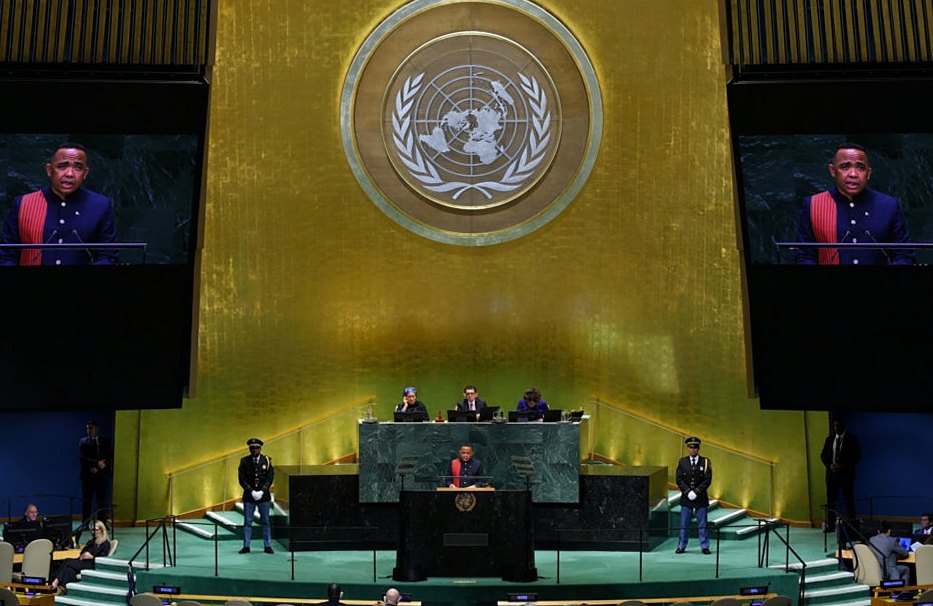
Key Moments from Day Three of the UN General Assembly
Based on reporting by PBS
Speeches by Benjamin Netanyahu and Mahmoud Abbas drew considerable attention at the UN on Thursday, though Abbas was absent in person — the United States had denied him a visa. Alongside those competing addresses, a number of other developments unfolded as presidents, prime ministers and monarchs took turns at the podium.
World leaders delivered a series of notable speeches at the United Nations General Assembly on Thursday, September 24, 2026, including addresses touching on Colombia's domestic challenges, Bolivia's political turmoil, Ghana's slavery resolution, and Paraguay's support for Taiwan.
Colombia's president speaks from home
Thursday marked what would have been Colombian President Abelardo de la Espriella's first address to the gathering of world leaders. De la Espriella, who took office last month, had pledged during his campaign that if elected he would not travel abroad, in order to concentrate on the country's internal challenges — particularly urban crime and violence linked to illegal armed groups. In keeping with that promise, Vice President Jose Manuel Restrepo delivered the speech on his behalf, stating that the words he presented were the president's own.
The address opened by acknowledging Colombia's resilience following a major earthquake last month that killed at least 289 people. On matters of security and economic growth, Restrepo conveyed that leaders are working to redirect "a country that is well aware of its difficulties but also of its enormous potential." Citing de la Espriella directly, Restrepo said: "Believe in Colombia. I don't promise you a perfect country, but I assure you that I am working tirelessly to build a nation that is safer, more prosperous and with more opportunities for its people."
Bolivia's president strikes a defiant note
Bolivia's Rodrigo Paz, now ten months into his presidency, has weathered significant instability at home. Several of his original cabinet ministers have departed following political disputes, corruption scandals and street protests. An attempt to address Bolivia's fuel shortages went wrong when contaminated gasoline caused damage to more than 10,000 vehicles. His government's seat was also surrounded by protesters calling for his resignation for nearly eight weeks.
Despite that backdrop, Paz took a combative stance before the assembly on Thursday, asserting that the economy is improving, fuel shortages are being managed and citizens are looking ahead. He argued that socialism "does not put food on the table," and said that in voting for him, Bolivia "decided to engage in a change and a transformation and to not turn back to the past." He closed with what may stand as the assembly's most striking line: "Long live the fatherland, damn it! Long live Bolivia."
Ghana references Trump's 'annihilate' remark
Ghanaian President John Dramani Mahama appeared to allude to remarks made by US President Donald Trump on Tuesday, during which Trump suggested he might "annihilate" Iran. Mahama told the assembly: "No human civilization deserves to be annihilated, and certainly not a member of the United Nations." He also highlighted a resolution recognising the crimes of the transatlantic slave trade, expressing gratitude to the 123 nations that voted to affirm it. Ghana, formerly known as the Gold Coast, served as a significant slave trafficking port during the 1600s and 1700s.
"No race is superior. No nation is inferior. No child's life is worth less because of the language they speak, the faith they profess, the color of their skin or the land of their birth," Mahama said. "This is the unyielding moral foundation upon which the United Nations must stand."
Paraguay reaffirms support for Taiwan
Paraguayan President Santiago Peña used his assembly address to restate his country's backing for Taiwan amid tensions in the Indo-Pacific. "Paraguay stands, and I say this loud and clear, with Taiwan," he declared. Paraguay is the only South American nation and one of only 12 countries worldwide that recognises Taiwan. Beijing views Taiwan as its own territory and has in recent years intensified efforts to draw away Taiwan's diplomatic allies while also increasing military pressure on the island.
Peña described Taiwan as the world's central hub for microchip manufacturing and argued that instability in the region has direct consequences for chips that "drive industry, defense and artificial intelligence." He warned that the situation's global reach is often underestimated: "What happens there is not merely a regional matter ... It affects Japan, all of East and Southeast Asia, and, above all, it affects the global economy. Anyone who pretends that this is far away or too distant simply has not understood the 21st century."
On a lighter note, a press conference on global education held within the UN complex drew complaints about the temperature in the briefing room. As fall arrived and New York temperatures dropped, attendees found the room uncomfortably cold. UN deputy spokesperson Farhan Haq, who moderated the event, acknowledged the chill with a laugh, saying of the room's temperature: "It's whatever the weather is like outside – and more."