Harvard Scholar Traces Fairy Tale Expertise to Attic Relics and Refugee Childhood
Based on reporting by Harvard Gazette
Maria Tatar's family arrived in the United States from postwar Europe as displaced persons, settling in Highland Park, Illinois, after a church congregation sponsored them when a promised job for her father in Seattle fell through without explanation. Her parents came to New York City with three children — a fourth on the way — and $200. Her father worked first as a chauffeur and then as a carpenter while preparing for U.S. medical board exams, eventually qualifying as a licensed ophthalmologist.
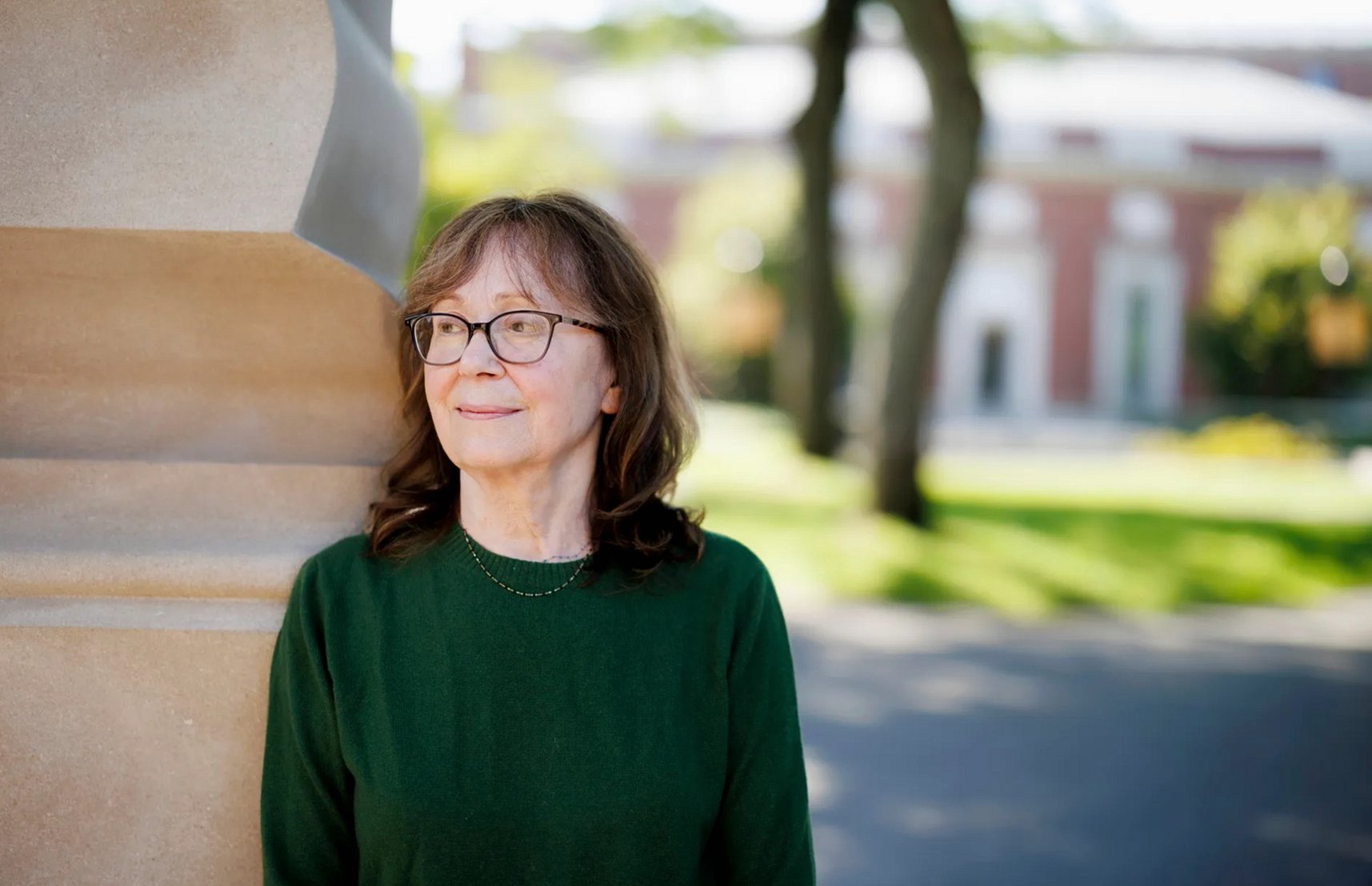
Maria Tatar, John L. Loeb Professor of Germanic Languages and Literatures and Folklore and Mythology, Emerita, at Harvard, describes how her early life as a postwar refugee and a childhood attic filled with a German copy of Grimms' fairy tales and a World War I helmet shaped her scholarly path.
Tatar was five years old when she received a laminated card in the mail identifying her as a displaced person and resident alien, with fine print warning of imprisonment for failing to report a change of address. She says she anxiously tracked every move her family made to ensure the authorities were notified. The label 'displaced' struck her as bewilderingly vague — 'a random piece of cargo that has landed in the wrong warehouse' — while 'resident alien' made her feel like a creature from another planet. Over time, she says, the experience of feeling like an outsider gave way to a streak of fierce independence.
A library card as passport
Highland Park, a town of 30,000, was home to no other immigrant family she knew of. Her earliest memory is the smell of waffles in the kitchen of the sponsoring family. She found what she calls a second home in the Highland Park Public Library, where, through books, she traveled alongside Jules Verne's Michael Strogoff, visited Dickens's Micawbers in debtors' prison, and accompanied Charlotte Brontë's Jane Eyre through Lowood School. Her library card, she says, was 'a magical passport — a portal into an education.'
The church-donated mansion where her family lived was a large, rambling building with empty rooms and a cluttered attic that, for four children, was filled with treasures and haunted by ghosts. Among its relics were a German-language illustrated edition of Grimms' fairy tales — one of the three languages she spoke as a child — and a World War I German helmet, a Pickelhaube made of leather and polished metal, a design the German Army abandoned in 1916 after its gleaming spike made the wearer an easy target.
Tatar describes those attic objects as having whispered in her ear and says she wonders whether a kind of sensory overload from the Grimms' illustrations drew her toward the stories later in life. She adds that the ghost of the soldier who once wore the helmet has made itself at home in her imagination, and she questions whether that image eventually led her to translate Erich Maria Remarque's novel about the First World War, 'All Quiet on the Western Front.'
From refugee child to Harvard faculty
She completed undergraduate studies at Denison University, where she worked with historian William Preston Jr., author of 'Aliens and Dissenters,' a book on federal suppression of left-wing radicals, and with Guy Stern, a scholar of German language and literature, a Holocaust survivor, and one of the Ritchie Boys — a secret U.S. intelligence unit largely composed of Jewish refugees who had fled Europe to escape the Nazis. A desire to return to her Hungarian roots and to understand Germany's path to National Socialism took her abroad to Munich and later to the Free University in Berlin.
She earned her doctorate from Princeton University, where she says she felt at home among other bookish students, and joined the Harvard faculty in 1971. She is now the John L. Loeb Professor of Germanic Languages and Literatures and Folklore and Mythology, Emerita, and continues as a Senior Fellow in Harvard's Society of Fellows. At Princeton, she recalls, her final year coincided with a hiring freeze, and rejection letters became wallpaper. German departments of that era, she says, maintained a strict code of silence around the Holocaust and did not take fairy tales seriously, treating the Brothers Grimm as writers of mere children's stories.
Her turning point came in 1976 on a Modern Language Association panel alongside Bruno Bettelheim, whose book 'The Uses of Enchantment' had just declared fairy tales psychologically complex and therapeutically valuable for children, effectively legitimising the genre as an academic field. Tatar says the nursery door blew off its hinges: fairy tales were suddenly understood as what John Updike described as 'the television and pornography of an earlier age' — raw, communal entertainment told around hearths to the sounds of spinning wheels and domestic chores on long dark nights.
Teaching the soul of human storytelling
At Harvard, Tatar introduced fairy tales into a course titled 'The History, Philosophy, and Literary Culture of Childhood.' She describes the curriculum as an excavation of human storytelling, encompassing myth, fairy tale, and story as triumphs of the human imagination. Her students, already versed in Grimm, Hans Christian Andersen, and D'Aulaires, wanted not simply to reread the classics of children's literature but to unpack their hidden meanings and understand their lasting appeal.