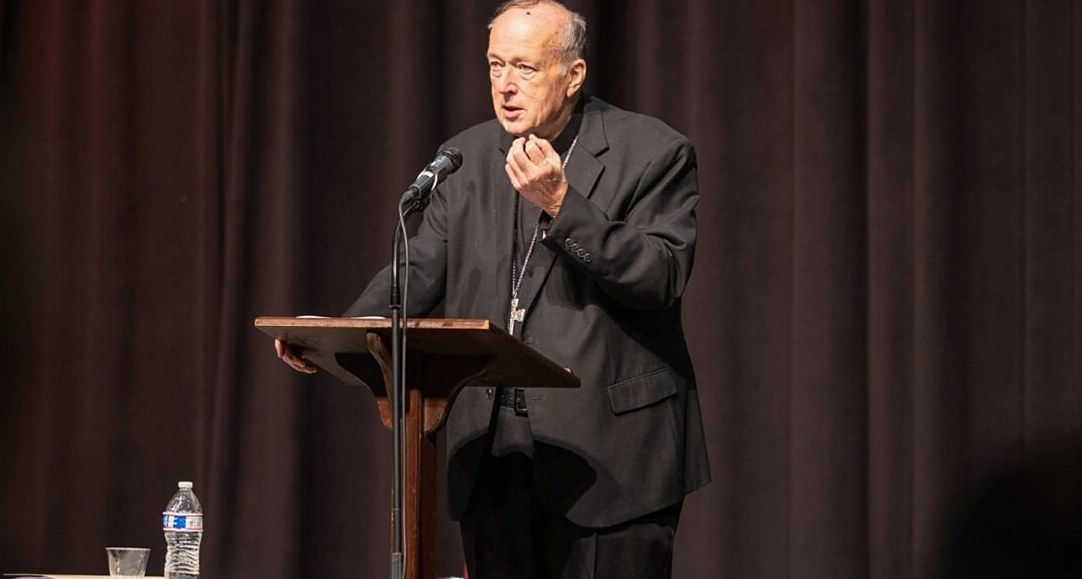
Cardinal McElroy Delivers Lecture on Digital Age and Catholic Social Doctrine
Based on reporting by Catholic Standard
Cardinal McElroy opened his remarks by recalling the conclusion of the conclave that elected Pope Leo, noting that after offering his promise of obedience he told the new pontiff, "You picked a great name." He explained that every pope makes a statement through the name chosen, and that in selecting Leo, the new pontiff signaled an intent to embrace the broad history of Catholic social doctrine rooted in Pope Leo XIII's 1891 encyclical Rerum Novarum.
Cardinal Robert W. McElroy, Archbishop of Washington, delivered the Thomas Verner Moore Lecture at St. Anselm's Abbey School in Washington, D.C., on September 26, 2026, addressing the moral challenges of the digital age in light of Pope Leo XIV's encyclical Magnifica Humanitas.
Rerum Novarum, meaning "new things," directly addressed the sweeping consequences of Western industrialization for social and family life, wealth and income, and human dignity. It also proclaimed the Church's obligation to bring the Gospel and Catholic teaching to bear on the turbulent shift from agrarian to urban society, and established a mandate for every subsequent era to examine emerging realities in light of that same tradition.
Pope Leo XIV's Magnifica Humanitas
Following that mandate, Pope Leo XIV issued Magnifica Humanitas in response to a technological revolution that the encyclical suggests may ultimately exceed the transformations brought by industrialization. The document states that "we must ask God for the wisdom to interpret the great trends of our time, particularly technological advances," observing that digitalization, artificial intelligence, and robotics are reshaping the world with increasing speed and depth.
The encyclical makes clear that the Church does not take an antagonistic stance toward these changes, acknowledging the benefits they can bring to medicine, the acquisition of knowledge, and economic life. At the same time, it calls for approaching digitalization with the recognition, long held in Catholic teaching, that technological innovation carries ambiguous consequences across many dimensions.
Magnifica identifies a fundamental difference between the creation of a digital world and prior eras of technological change. Quoting the encyclical, Cardinal McElroy cited its observation that emerging technologies are now "interwoven into the fabric of daily life, shaping decision-making processes and deeply affecting the collective imagination," adding that "never has humanity had such power over itself." The document notes that the long-term effects on individual dignity and the common good remain not yet fully predictable.
Babel, Jerusalem, and Dialogue
Cardinal McElroy identified several piercing ethical questions flowing from this reality: technological change with universal reach, a transformation of collective imagination, rapid acceleration of access to knowledge, raw power concentrated in the hands of a few entities effectively beyond governmental reach, and the question of whether privacy can survive in a digital world. He described these as rooted in the deepest anthropological questions about what it means to be human.
He noted that Magnifica grounds the Church's role in this dialogue in a theological vision centered on the Incarnation, with the encyclical stating that "it is only in the mystery of the Word made flesh that the mystery of humanity truly becomes clear." The document calls on Catholics to contribute to initiatives building a more just world and to engage in dialogue with all people in identifying new paths for the common good.
Pope Leo draws on two biblical images to frame this dialogue. The Tower of Babel represents human striving for power detached from any truly humanizing goal, producing a culture of domination and uniformity that is destructive and unsustainable. By contrast, Nehemiah's collaborative rebuilding of Jerusalem after the Babylonian captivity — listening to the people, giving all a role, and valuing every resident — points toward a model of inclusive, spiritually grounded engagement with the digital age.
The encyclical warns against what it calls the "Babel syndrome": the idolatry of profit that sacrifices the weak, a uniformity that neutralizes differences, and the assumption that a single language — even a digital one — can reduce everything, including the mystery of the person, to data and performance. A genuinely moral global dialogue on the digital future, Cardinal McElroy argued, must instead be rooted in human diversity, the equal dignity of all, and a willingness to limit scientific achievement when it can only be accomplished through profound injustice.
Catholic Social Doctrine as Foundation
Cardinal McElroy highlighted what he described as one of the most surprising elements of Magnifica Humanitas: roughly forty percent of the document is devoted to a comprehensive presentation of the key principles of Catholic social doctrine, constituting on its own terms an illuminating compendium of the Church's social teachings and a distillation of the doctrinal tradition stretching back to Rerum Novarum.
He offered his interpretation of why Pope Leo chose to survey the entirety of Catholic social doctrine in addressing the digital challenge: the moral questions raised by contemporary technology are so broad that they draw on virtually every moral insight developed in Catholic social reflection over the past one hundred fifty years. The encyclical itself states that artificial intelligence "should not be considered as merely yet another theme to be studied or a crisis to be managed, but rather as a development that challenges the categories of Social Doctrine from within, calling for their further development in fidelity to the Gospel."